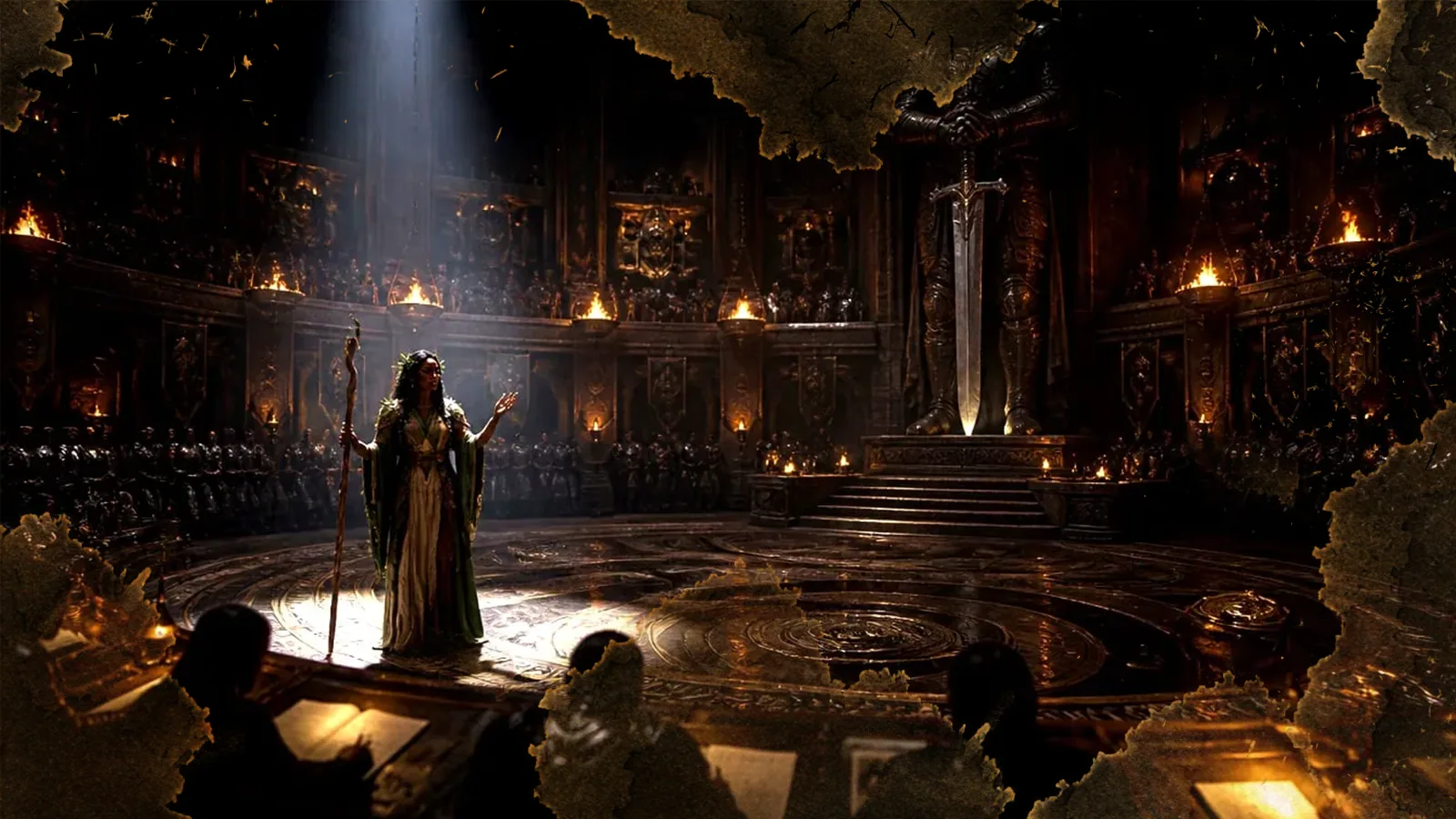
This is an account of the speech delivered by the High Druid Ayana in the Grand Temple of Halshire, in Dymarth City, before the assembled Council of the Alliance. Its words were fortunately preserved in their entirety by the tireless scribes of the temple and are here rendered into the Thergen tongue. Though Ayana spoke in her native Sin-Ba, great effort has been made to preserve not only the meaning of her words, but also the way they were spoken. The only liberty taken by the author concerns punctuation and the division of certain passages, for the long years that have since passed have left few alive who heard the speech with their own ears.
At the time, Ayana’s words provoked fervent outrage among the clergy. Her teachings were condemned as blasphemous, and she was banished from the lands of Therasya. Yet two further Darknesses have since fallen upon the mortal kingdoms, and perhaps suffering has made us more willing to consider that which our forefathers were too rigid to hear. What was once dismissed as irreverence may, with the distance of the Spires, reveal itself as wisdom.
The author considers this discourse one of the clearest surviving proofs of the Sinbandian understanding of the Cosmos and, most importantly, of the nature of Harmony herself. Ayana does not diminish the Goddess by questioning the limits of her dominion; rather, she attempts to understand what such limits must mean in a creation where Order, Chaos and mortals coexist. Whether all her conclusions are correct I leave, as she herself would surely have wished, to the judgement of the reader.
Alas, in such matters the northern continent has not advanced philosophically as far as our southern brethren. Perhaps peace and the bounty of their lands granted them the leisure to contemplate such wondrous questions, while we spent those same centuries raising walls, burying our dead and holding back the hordes of Entropy. Yet one should not resent another man for having time to think. Better that his thoughts survive, so that when our swords and spells are finally laid aside, we may decide whether they were wise.
Tifrim, archmage of Elemendia
Melodies of Harmony and Dissonance
Let us begin, my students, with that which I consider an axiom.
The concepts perceived within the intellect of Harmony can only be benevolent in their original nature. This is not to say that everything Harmony does must appear good to mortal eyes, nor that every consequence of Order must bring comfort. It means only that the ideas first conceived within her nature cannot contain their own negation.
For although Harmony descended from an entity that encompassed every aspect and every possible instance of Order, she did not inherit the entirety of that being. Neither, I believe, did Entropy or Void. Their progenitors were omnipotent, and the greatest proof of this is that they possessed even the power to determine their own ending. Their children are vast beyond mortal comprehension, perhaps omnipresent within their respective natures, yet they remain limited where the First Gods were not.
We must therefore distinguish between an idea and its counterpart.
Consider Peace.
Harmony understood Peace, for Peace existed within her intellect. Yet War she could not conceive. War was not merely another thought beside Peace, for if Harmony had possessed both equally, then no corruption by Entropy would have been required. Rather, Peace and War existed as a dyad, as the two possible faces of an older archetype whose complete nature once rested within the primordial whole.
Entropy did not create War.
This distinction, though small in speech, is enormous in consequence.
Entropy deprived Peace of its primacy and drew forth its opposing image. He uncovered what existed behind it. He did not fashion War from nothing any more than a man who breaks a vessel creates the fragments that follow. He merely brought into actuality a state that had previously remained concealed.
And what occurred thereafter?
Harmony herself employed War.
When she could not harm her forefathers under the dominion of Peace, she could act only after its opposite had entered creation. She then took this newly manifested principle and turned it against the Primordial Gods themselves.
Listen, for from this one event we may derive something remarkable.
If War belonged absolutely to Entropy, Harmony could never have wielded it.
Therefore War cannot belong to him.
Nor, however, does it belong to Harmony.
Who, then, commands it?
The impatient student might answer: perhaps some higher power, concealed from us, stands above them both.
But this answer merely creates another question and solves nothing. For then we would be obliged to discover who commands that power, and who commands the next, until philosophy becomes an endless staircase whose upper steps we invent simply because we are afraid of leaving the sky empty.
I propose a simpler conclusion.
No one commands War completely.
War is governed first by its own nature and secondly by its relationship to Peace.
Every original concept and its distorted counterpart remain joined. The mirror circles the primary even when the two appear opposed. War may destroy Peace, yet without the meaning of Peace there could be no meaning to War. Betrayal cannot exist where loyalty is meaningless. Cruelty has no significance without mercy. Falsehood requires truth against which it may be measured.
Thus the distorted concept is not free merely because it is chaotic.
It is chained to that which it opposes.
Harmony possesses authority over the original expression of the archetype. Entropy possesses the power to reveal and awaken its counterpart. Yet neither possesses sovereignty over the bond between them.
That bond is older than either.
Perhaps it is among the few surviving laws of the First Creation.
The Man Who Unlocks the Cage
We may therefore say that Entropy has committed an act even more dangerous than dominion. He has set powers into motion which do not entirely obey him.
He is not a king placing soldiers upon a field.
He is the man who unlocks the cage.
He is the man who unlocks the cage.
Where the beasts thereafter run is another matter entirely.
This explains why the distorted concepts often act against even Entropy’s immediate interests. Hatred consumes allies as easily as enemies. Ambition turns servants against masters. War destroys the victor together with the defeated. Deception eventually makes cooperation impossible even among deceivers.
Entropy may manipulate such things, he may empower them, call to them and profit from their effects.
But he cannot make Chaos cease being chaotic.
Indeed, if Entropy possessed perfect command of every distorted concept, he would cease to embody his own principle. Absolute control is itself a form of Order. A perfectly disciplined Chaos is a contradiction in terms.
Here, then, lies the peculiar balance between Harmony and Entropy.
Harmony possesses greater control, but greater restriction.
Entropy possesses lesser control, but greater freedom.
Harmony may direct the concepts closest to her nature with purpose and continuity. Entropy releases their counterparts with far fewer restraints, but by doing so accepts that their consequences may turn in directions even he did not intend.
One holds the reins tightly, while the other cuts them.
Neither therefore possesses a clear advantage.
A student may now ask me whether this means Harmony is the stronger of the two.
I answer that the question itself is incomplete.
Stronger in what manner?
A fortress is stronger than a river if we ask which better withstands an assault. Yet the river is stronger if we ask which may pass and bend around the fortress and continue toward the sea.
Harmony’s power comes through structure. Her actions are constrained by what she is. She possesses purpose, direction and what mortals would call ethos. She seeks a conclusion, a finite ordering of existence that forms part of her Great Plan.
Entropy seeks no such conclusion except the ending of conclusions themselves.
His destination is dissolution.
Thus, Harmony is more capable of directing what belongs to her, while Entropy derives strength precisely from his inability to impose lasting direction upon what belongs near him.
The Most Common Error
And now we must discuss morality, for here mortal scholars make their most common error.
They frequently travel beside one another, but companions must not be mistaken for the same person.
To mortal societies, Order often appears benevolent because it creates the conditions in which benevolent things may endure. Laws restrain murder. Agreements permit trade. Families preserve knowledge. Cities protect the weak. Memory allows wisdom to pass from one generation to another.
For these reasons mortals quite naturally associate Law with Good.
Yet uninterrupted Order may also produce stagnation, tyranny and complacency. A society in which nothing may ever change eventually ceases to grow. The law that protects today may imprison tomorrow.
Likewise destruction, although commonly associated with suffering, is not always evil.
A diseased limb may be removed so that the body survives.
A forest burns and new growth follows.
A corrupt kingdom may require rebellion before justice can return.
Even War, the counterpart of Peace, may preserve lives when employed against something that would otherwise consume them.
We must therefore assume that Harmony understands this.
She uses ideas from both sides of the mortal conception of good and evil because her purpose is not the comfort of every individual moment. Her vision extends across Spires. That which appears cruel within a year may prove necessary across a millennium.
This does not make her evil, nor does it make suffering unreal.
It merely reminds us that the observer determines much of what he believes he sees.
Imagine an ant upon a mosaic. It sees only the black stone beneath its feet and declares the entire work dark. Another stands upon white and declares it bright. Neither lies, but neither understands.
So too are mortals when judging beings whose thoughts stretch across ages.
But what, then, of Order for its own sake?
Here lies another danger.
If Ideas possess total universal existence independent of those who employ them, then Harmony and Entropy cannot be understood as simple collections of virtues and vices.
They are not merely Goodness and Evil wearing grandeur names.
They are directions.
Harmony seeks relation, continuity, structure and purpose.
Entropy seeks separation, dissolution, unpredictability and the destruction of all.
Good and Evil may arise within either movement according to circumstance, although some combinations are far more common than others.
Where the Axes Cross
And this brings us finally to mortals.
Why were mortals not fashioned purely from Harmony?
Because such beings would scarcely possess choice.
A creature entirely ordered would follow its nature with the inevitability of water descending a slope. It might be beautiful, perhaps even perfect, but we could hardly call it free.
Mortals contain both tendencies.
Within every person exists the desire to build and the desire to break, to preserve and to abandon, to obey and to rebel. A man may love his family yet murder his enemy. A queen may maintain perfect laws while ruling without mercy. A thief may violate the law to save a starving child.
Thus the mortal soul moves not upon one line but upon at least two:
Order and Chaos.
Good and Evil.
And because these axes cross rather than overlap, the moral universe becomes vastly more complicated than the sermons of simple priests would have us believe.
Free will exists within that crossing.
Harmony does not desire creatures incapable of departing from her road. Such creatures would not follow the Great Plan. It would merely carry them.
The merit lies in choosing the road when another is possible.
Why Chaos Cannot Keep Its Victory
This, I believe, also answers a question that has troubled theologians since the first Darkness:
Why can the demons never achieve permanent victory?
Because Chaos cannot preserve its own triumph.
Consider what victory requires:
Armies must cooperate.
Orders must be followed.
Supplies must arrive.
Strongholds must be maintained.
Knowledge must be preserved.
Leaders must trust servants, servants must obey leaders, and yesterday’s agreement must still possess meaning tomorrow.
All these are acts of Order.
The demon therefore suffers from a contradiction at the heart of his existence. The more completely he embraces Chaos, the less capable he becomes of constructing anything that can endure.
He may conquer a city, but he struggles to govern it.
He may gather a horde, but he struggles to keep it united.
He may overthrow a king, but sooner or later another demon asks why he should not become king instead.
Thus, demons may destroy civilizations of extraordinary power, yet their victories decay from within. Chaos is immensely powerful at opening wounds and remarkably poor at healing them.
This is also why Devils differ so greatly from Demons. The Devil accepts hierarchy, contract and discipline. He employs Order in the pursuit of wickedness. For this reason a Devil may maintain an empire where a Demon more naturally leaves ruins.
Evil can build.
Chaos may build, but every stone it sets in place imposes a restraint upon its own nature.
And therefore Chaos is, in many ways, more destructive than Evil.
Evil often desires something.
We see the hunger around us for:
Power.
Wealth.
Revenge.
Dominion.
Immortality.
Even the cruelest tyrant ordinarily wishes his kingdom to remain standing so that he may rule it.
Chaos in its purest expression desires no stable possession because possession itself establishes relation.
It does not merely desire the throne.
It questions why there should be a throne.
Then why there should be a kingdom.
Then why there should be borders.
Then names.
Then meanings.
Then distinction itself.
At the farthest end of Entropy lies not wickedness.
It lies dissolution.
The final victory of Evil might produce an unbearable world.
The final victory of Entropy would produce no world at all.
And perhaps this, my students, is why Harmony’s struggle has continued through every Spire.
She does not fight because all that opposes her is evil.
She fights because existence requires enough Order for anything, good or evil, love or hatred, peace or war, to continue possessing meaning.
For even Dissonance requires a melody against which it may be heard.
For even Dissonance requires a melody against which it may be heard.
— Set down by Tifrim, archmage of Elemendia